

South Carolina’s lakefront communities attract homeowners who want direct water access, scenic views, and a pace of life that’s harder to find elsewhere. A serene and slower pace of life that’s difficult to replicate anywhere else. Around Lake Murray and the surrounding Midlands and Upstate counties, properties are designed to take advantage of the outdoors. For most, that means large windows, covered porches, and open decks with breathtaking views.
But those same features come with a trade-off. The South Carolina sun doesn’t take a season off, and lakefront properties feel that more than most. Summer temperatures in the Columbia area regularly push past 90°F, and water reflection off the lake amplifies UV exposure in ways that a standard residential lot simply doesn’t experience. What we end up seeing is outdoor spaces that go underused during the hottest months, interior temps that keep your HVAC working overtime, and furnishings that fade well ahead of schedule.
The good news is that these are solvable problems. The right shade solution — or the right combination of solutions — genuinely changes how you live in your home.
Your Shade Options at a Glance
Sun Shades & Graphics offers a few different shade tools, and each one solves a slightly different problem. The key is choosing the right mix for your home.
Most lakefront homeowners end up choosing some combination of the following options:
- Retractable awnings for flexible patio/deck coverage
- Exterior Screens for side sun + glare on porches and openings
- Window film (LLumar) for UV protection and heat control on glass
- Interior roller shades for privacy + light control inside
- Permanent awnings for always-on shade at entries and windows
Retractable Awnings
Motorized retractable awnings are the most flexible option for decks and patios. They extend when you want shade and retract when you want full sun—or when weather changes quickly (which matters on lakefront properties with open southern/western exposure).
Sun Shades & Graphics installs Sunesta retractable awnings, custom-built to size, with optional upgrades like dimmable LED lighting, drop-down sunshades, remote controls, and wind sensors for automatic retraction. Warranties include a lifetime frame warranty and up to 10 years on fabric.
Permanent Awnings
Permanent awnings provide consistent, set-it-and-forget-it shade over fixed areas like entry doors, walkways, and windows. They also add a clean architectural look when the fabric and frame colors are chosen to match the home.
A common lakefront setup is permanent awnings on the front entry (street-facing) paired with a retractable system on the rear deck (water-facing).
Exterior Screens
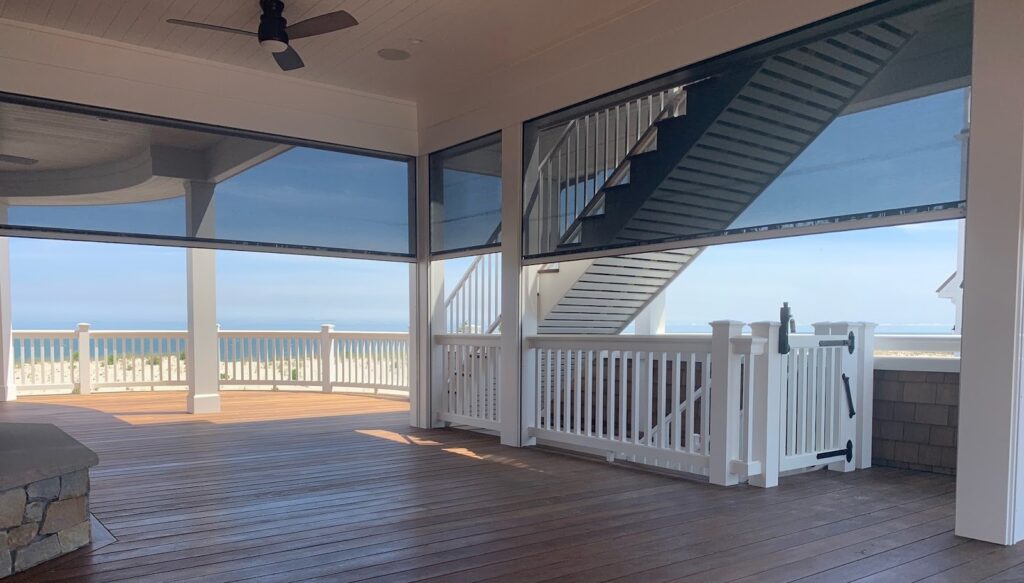
Exterior Screens mount outside windows or along porch openings and drop vertically at the push of a button. They stop heat and glare before it hits the glass, which makes them especially effective for screened porches, three-season rooms, and covered areas that still feel hot from side sun.
They block 65% of the heat and 100% of the glare, and because they’re Sunesta products, they’re built for outdoor exposure with smooth motorized operation and durable fabrics.
Interior Roller Shades
Interior roller shades mount inside and give you light control and privacy—manual or motorized—with fabric options ranging from sheer solar to room-darkening. They won’t stop heat as early as exterior solutions, but they’re a strong choice where outside mounting isn’t practical.
For lakefront homes, they’re especially useful in bedrooms and living areas where early sun off the water is intense. With smart controls, they can also be scheduled to raise/lower automatically.
Residential Window Tinting
Window film is always working because it’s applied directly to the glass. LLumar films reduce glare, help control solar heat gain, and protect interiors by filtering UV—without changing how you use the space.
LLumar films can block up to 99% of UV radiation while still letting in natural light, which helps protect floors and furniture without sacrificing the view. LLumar Low-E films also help reduce heat loss in winter, making them a strong option for year-round lakefront homes.
These solutions work well on their own and even better in combination. Many lakefront homeowners use retractable awnings or Exterior Screens on their outdoor living spaces, window film on their most sun-exposed glass, and interior roller shades in rooms where privacy and light control matter most. That layered approach addresses the full range of sun-related challenges a lakefront home presents.
Why Lakefront Conditions Specifically Require These Solutions
A lake-facing home experiences sun exposure differently than a typical residential property, and several factors combine quickly to make shade solutions more important in these settings.
- Water reflection amplifies UV exposure. Light bouncing off the lake’s surface creates secondary exposure that strikes windows and exterior surfaces from angles standard overhangs never reach.
- Humidity accelerates material wear. Fabrics and hardware that hold up fine inland can show premature deterioration near water without the right component selection.
- Wind exposure is more variable. An open lake lot with a southern or western exposure sees stronger and less predictable gusts than a sheltered suburban yard — which is exactly why motorized retractable systems with wind sensors are worth the upgrade in this setting.
- Pollen season is prolonged. South Carolina’s pollen season can stretch from February through May. Retractable systems let you protect outdoor furniture and surfaces during the worst of it by simply closing them up.
- Thermal load through south- and west-facing glass is substantial. On a typical July afternoon, an unprotected west-facing window can drive interior surface temperatures well above ambient air temperature, putting real, continuous strain on your air conditioning.
None of these are unique to lakefront living, but they all show up at the same time, in an amplified form, on the same property. That’s what makes getting the shade solution right matter a bit more here.
The Energy Efficiency Case
Shading is one of the most cost-effective ways to reduce residential cooling loads — the U.S. Department of Energy says so specifically in the context of south- and west-facing windows. For a lakefront home with generous glazing, this is worth taking seriously.
The reason exterior shading outperforms interior solutions comes down to where the heat gets stopped. Solar heat that’s already passed through your glass has already entered your home. Exterior Screens and retractable awnings intercept it before it makes contact with the glass, which is fundamentally more effective than trying to manage it inside with blinds or curtains after the fact.
Window film adds another dimension. LLumar Low-E films reduce heat gain in summer and heat loss in winter, which means they’re contributing to efficiency in both directions. For homeowners using their lakefront property year-round, that two-season benefit makes window film a smart long-term investment on top of whatever exterior solutions are in place.
Interior roller shades round out the picture. While they don’t block heat at the exterior the way awnings and screens do, they contribute meaningful UV filtering and can significantly reduce the workload on your HVAC by managing how much solar energy reaches interior surfaces. Combined with exterior solutions on the most exposed elevations, they help produce the best overall energy results.
Protecting Interior Finishes Over Time
One cost that tends to sneak up on lakefront homeowners is cumulative UV damage to interior finishes. Hardwood floors, upholstered furniture, area rugs, artwork — all of it degrades faster with prolonged UV exposure. In a home where natural light and water views are central to the design, this creates a real tension: you want the light, but you don’t want the damage that rides along with it.
UV-filtering window film handles this directly. LLumar residential films can block up to 99% of UV radiation while still allowing visible light transmission, so your rooms stay bright and your view stays intact. The practical effect is furniture and flooring that hold up at a significantly better rate over time — without changing the feel or look of the space.
This matters for resale value, too. A home with well-maintained interior finishes and professionally installed shade systems shows better and leaves less deferred maintenance for the buyer. In higher-value lakefront markets around Lexington, Richland, and Greenville counties, those details are noticed.
Ready to see your options in person? Sun Shades & Graphics brings a mobile showroom directly to your home so you can look at fabrics, films, and hardware in your own light before committing to anything. Schedule a visit here or call 803.798.2665.
Choosing the Right System
Not all shade products perform equally in South Carolina’s climate, and a poor match leads to frustration and replacement costs within a few seasons. After 45 years of installations across the Midlands and Upstate, we’ve seen what holds up and what doesn’t.
On retractable awnings: Motorized systems outperform manual options on lakefront properties simply because of how quickly conditions can change near the water. The ability to retract in seconds — automatically, if you choose a wind sensor — removes the risk of leaving an extended awning in weather it wasn’t designed for. All Sunesta retractable awnings installed by Sun Shades & Graphics come built to exact measurements, with a lifetime frame warranty and 10-year fabric warranty. Budget awnings from big-box retailers typically fade and lose structural integrity within two to three seasons under South Carolina sun. The comparison isn’t close.
On fabric selection: Sunesta’s fabric collection is engineered for prolonged UV and humidity exposure. With 134 options across a range of colors, textures, and opacity levels, there’s enough variety to match any exterior aesthetic without compromising on performance. Fabrics are tested for outdoor durability, and the Sunesta fabric warranty covers 100% of replacement costs for the first eight years.
On permanent awnings versus retractable systems: Both have their place on a lakefront property. Permanent awnings are ideal for fixed protection over entryways, windows, and walkways where consistent shade is the goal and flexibility isn’t needed. Retractable systems are the right call for primary outdoor living spaces where conditions change throughout the day and across seasons. In most cases, the best outcome uses both.
On exterior versus interior roller shades: Exterior Screens intercept heat before it reaches the glass, making them the stronger thermal performer. Interior roller shades are the better choice for rooms where an exterior mount isn’t practical, or where light control and privacy are the primary goals. For maximum performance, layering both on the most sun-exposed elevations gives you control over the full range of conditions.
On window film: LLumar films offer a passive, always-on solution that requires no operation and very little maintenance. They’re particularly effective on large picture windows and glass doors where the view is non-negotiable. The Low-E options provide year-round value for homeowners using the property in every season.
On installation: A correctly mounted awning or shade handles wind load better, tracks evenly, and retains its warranty. Sun Shades & Graphics handles all installations in-house — not through subcontractors — which keeps quality consistent across every job. Our team has over 75 years of combined installation experience, and that shows in how the product performs after we leave.
Maintenance Considerations for Lakefront Properties
Any outdoor shade system needs periodic attention, and that’s especially true in the kind of high-humidity, high-pollen environments you get near water. Keeping up with a few basics goes a long way.
- Retractable awnings should be pulled in during extended rain and any wind advisory. Most motorized Sunesta systems offer optional wind sensors that trigger automatic retraction when gusts exceed a set threshold — a worthwhile upgrade for an exposed lake lot. When it comes time to clean the fabric, a gentle brushing and a rinse with mild soap and water is typically all that’s needed. Avoid pressure washing, which can stress the fabric weave.
- Exterior and interior roller shades should be retracted or raised during heavy weather and cleaned periodically with a soft cloth and mild soap. Avoid anything abrasive that can degrade the fabric surface.
- Window films are the lowest-maintenance option in the lineup. A soft cloth and mild glass cleaner keep them clear. The only things to avoid are ammonia-based cleaners and abrasive tools, both of which can damage the film surface. Beyond that, LLumar films are designed to last — they don’t require seasonal treatment or professional servicing under normal conditions.
For homeowners who prefer a structured annual maintenance approach, Sun Shades & Graphics offers service consultations. Reach the team through the contact page to discuss options.
The Right Shade Solution Is Out There for Your Home
Lakefront living in South Carolina is worth protecting. The right shade solution — whether that’s a motorized awning over the rear deck, Exterior Screens on the porch, window film on the south-facing glass, or some combination of all three — extends how long you can comfortably use your home’s best spaces, keeps your interior in better shape over time, and makes a real difference in what you spend on cooling each summer.
Sun Shades & Graphics has been solving these problems for homeowners in the Columbia and Greenville areas since 1980. We carry Sunesta awnings and shades and LLumar window films because they’re simply the best products available for this climate, and we stand behind every installation our team completes. When you’re ready to figure out what makes sense for your property, we’ll bring the showroom to you — no pressure, no guesswork, and no subcontractors.
Contact us here or call 803.798.2665 to schedule your in-home visit. And check out our blog for more on product selection, maintenance, and making the most of your outdoor spaces across all four seasons.